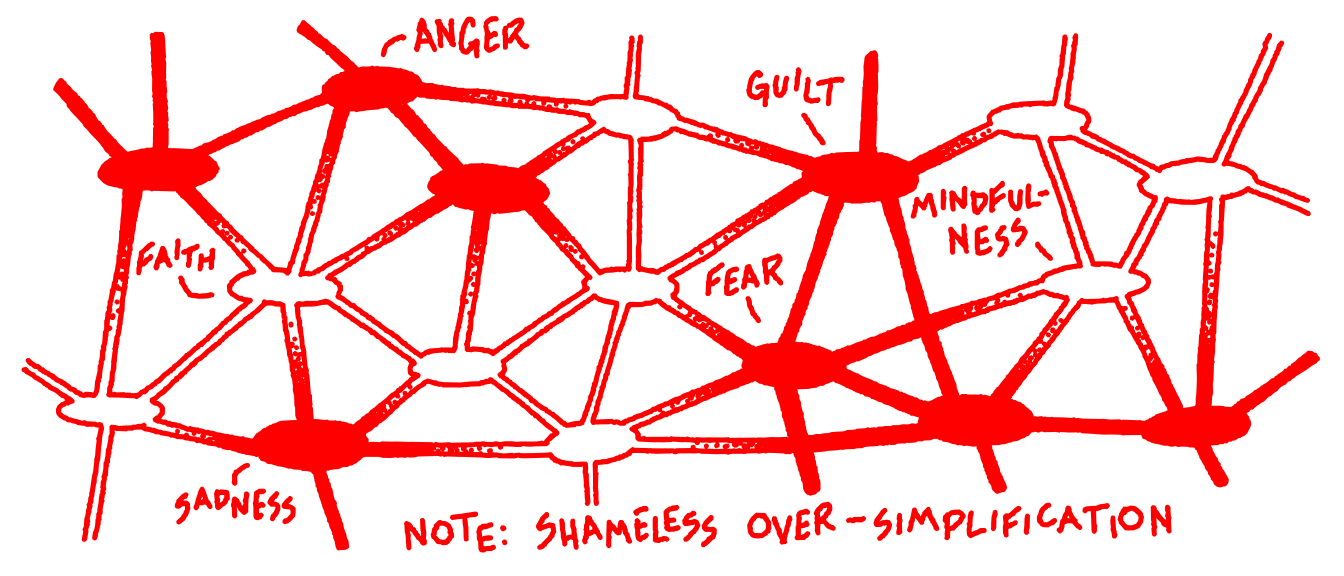
Transforming Internal Formations pt. 10

I want to say a few final words about what looks to us like the end of Jim’s internal formation. First of all, some bookkeeping: the transformation does not mean that the next time he looks at a pair of shoes his heart overflows with joy. It’s very likely that with a formation like this there will be a long-lasting physiological footprint. The old tensions and affective responses will arise naturally, but they will not get traction. Whether these old pattens will completely dissipate depends on the other conditions of Jim Bootman’s store consciousness. It’s like a storm that has lost its ability to draw in new air. The rain that is falling still falls and the wind that is blowing still blows. Depending on conditions, it may blow itself out completely or it may be swept up into another storm system.
So what happens when Jim walks into his workshop and sees a pair of Italian leather wingtip shoes on his workbench? Do they cause him anxiety? This is a little bit of a trick question. From within the frame of the question, I guess we can say that no, they don’t. They can never give rise to the same felt sense of this being a problem. But the question is based on our old idea of Jim, and people, this is not the same Jim Bootman! The “issue with shoes” became irrelevant as soon as he started seriously questioning it. If he is building up a personal narrative around the practice, it may still have some spark. He may tell us, “I transformed my fear of shoes!” But if he doesn’t entertain a spiritual identity, he’ll say something very dull like, “Oh that? It doesn’t bother me the way it used to.”
The Death Throes
As an internal formation falls apart, you lose your ability to interpret it. For lack of a better word, I will say that it becomes more and more abstract. An exact analog is whole-body awareness. The awareness of the field of the sensations of the body is a world apart from the conceptual designation, “body.” At first, the awareness of this abstract thing may give rise to concrete labels: “my anxiety, this thing, nothing,” et cetera. But as the formation decoheres, and perhaps especially if you’re sitting in an armchair, deeply relaxed after a long day of work, more of the human interpretive apparatus may be mobilized.
The thing is, not only conceptual labels are interpretations. The whole intuition of a world and a self in relation to that world is also a construction of our interpretive faculties. Jim did not uncover a hidden childhood memory. The mind just did what it always does: it constituted a present moment from conditions. As a formation repeatedly falls apart, it can give rise to present moments that feel much more profoundly “me” than any label. Depending on conditions, these thoughts and images can be so vivid as to merit the term “visions,” and are what I call the death throes of the formation.
Because these experiences do not necessarily always occur, and are not necessarily a part of any meaningful transformation, they tend to be handled in one of two ways: either complete dismissal or complete fascination. But an important part of Jim’s insight process was that he took his memory just seriously enough. He didn’t interpret, negotiate, or reject. He maintained his orientation, which is incidentally what the Buddha recommends. Here I will shamelessly edit down a sutra in which a monk comes to the Buddha with a related question:
Mahali: “Sir, a few days ago Sunakkhatta the Licchavi came to me and said: ‘Mahali, soon I will have been living in dependence on the Buddha for three years. I see heavenly sights that are pleasant, sensual, and arousing, but I don’t hear heavenly sounds that are pleasant, sensual, and arousing.’ The heavenly sounds that Sunakkhatta cannot hear: do such sounds really exist or not?”
Buddha: “Such sounds really do exist, but Sunakkhatta cannot hear them.”
Mahali: “Surely the mendicants must lead the spiritual life under the Buddha for the sake of developing the capacity to hear such heavenly sounds?”
Buddha: “No, Mahali, the mendicants don’t lead the spiritual life under me for the sake of realizing such a development of such a capacity. There are other things that are finer, for the sake of which the mendicants lead the spiritual life under me.”
He goes on to explain that what is even more interesting than heavenly sounds is transforming suffering.
Epilogue
By rights our story of the internal formation and of Jim Bootman is over, but something remains to be said about the Seventh Consciousness. Mr. Bootman himself has never heard of manas. He might not even have heard to the Five Aggregates. He has just been taking care of feelings, dwelling happily in the present moment. But he has been reconditioning his whole mind, and it has had far-reaching effects. Remember the way that Thay describes manas:
Manas…
- …seeks pleasure (or pleasant vedana).
- …avoids suffering (or unpleasant vedana).
- …is ignorant of the dangers of pleasure (or pleasant vedana).
- …is ignorant of the goodness of suffering (or unpleasant vedana).
- …is ignorant of the law of moderation.
- …grasps onto the flow of the manifestations from store consciousness as I, me, mine.
Actually, from a technical, Yogacara standpoint, manas only does the last thing in this list. And manas does not “do” it. Manas is a description of the systematic distortion of the unliberated mind. This distortion is comprised of four root afflictions, which I’ll present in order of subtlety.
- Self-Delusion – This is a kind of obscuration. It is the inability to see that there is nothing in the present moment that can actually bear the load of being called an enduring “me.” Because it is a lack of seeing, the practice can eliminate it. A curiosity here is that this can really only be seen at the moment of insight. Before that, it is invisible. After that, it no longer arises.
- Self-View – The imputation of an enduring standpoint that can observe change across moments. “I am aware.” This is subtle.
- Self-Conceit – The framing of experience in relation to that standpoint. Tracking implications for that standpoint. “I’m like this. How will this work out for me?” This is noticeable.
- Self-Love – Being wrapped up in “what’s good for me.” This is the most obviously afflictive function. “Augh!”
Although the suffering associated with Self-Love is obvious, it is not obvious to interpret that suffering in terms of the functioning of the eight consciousnesses or of manas specifically. That’s part of why deep structural change doesn’t just happen even though everybody is trying to do something about their suffering. Most ways of trying to ameliorate the situation still work within the framework of an enduring self and therefore never strike at the root of the problem. Whether or not anyone actually needs to have insight into this is a matter of debate for people more passionate than myself.
For Jim, who has become a bit of a mindfulness practitioner and quite a happy person along the way, this isn’t even on his radar. And it doesn’t need to be. In fact, he may rest on his laurels for some time. The essential precondition for the transformation of manas is a felt sense of necessity, of urgency. Jim Bootman’s heartfelt vow, as I recall, was only to transform his curious trepidation towards shoes, and he carried it to completion.