Transforming Internal Formations pt. 4

Gather round, gather round! I will tell you a story. I heard it from the old turnip-seller down at the market. It is the kind of story that walks from mouth to mouth, from village to village, from time long past to time unforeseen. Maybe you have heard it before, maybe not. It is the age-old story of Jim Bootman and his internal formation.
Here, crowded around the hearth to listen to our tale, we are removing ourselves from time as it can be known in the present moment. In the present moment, there is no past except in the form of a mental reconstruction called memory. There is no future except in the form of a mental projection called anticipation. The present moment is an island. Our story will not reflect that reality. Our story will look down upon an archipelago from far above. Just bear in mind that for our hero Jim Bootman, the man who made the most out of life on that island, this story is as much a fiction as it is for you and me.
Jim Bootman, humble cobbler and family man, has suffered with an unfortunate and inexplicable workplace anxiety for years. The mere sight of shoes instills in him a profound mistrust. By chance, he was hired to be the on-call shoe repairman for a walking tour of Northern India called “In the Footsteps of the Buddha.” Cue the inspiring conversion montage: Jim listens with wonderment during his first Dharma talk, walks mindfully up the mountain to Vulture Peak, savors his food with rapt attention during silent meals, clumsily tries a cross-legged sitting posture for the first time, and finally, on the day of departure, shares many a tearful embrace with his new lifelong friends, each one dragging out the last moments of the retreat for as long as humanly possible before returning to their respective countries and lives. The retreat organizers are thrilled because Jim, besides taking excellent care of their shoes, was very photogenic and perfectly happy to allow photos taken of him to be used in marketing materials for next season. Jim himself, upon returning home from his trip, feels that he finally has the tools to work constructively with his anxiety.
Although the complete picture of the path that Jim Bootman will take to transform his internal formation would include things like his formal practice routine, continued Dharma study, and Sangha relationships, here we are only going to look at the moments that qualify as “practicing with the internal formation of shoemending anxiety.” Also, we are going to assume that Mr. Bootman is what Thich Nhat Hanh would call, a “good practitioner.” That means that despite the fact that he doesn’t exactly know why or how it will work, he is only going to practice exactly what Thay recommends: dwelling happily in the present moment. In all of the bewildering diversity that is to follow, this is all he will do. What? Let’s look at the technical phrase Thay uses to characterize Plum Village practice:
    miên mật               hiện pháp             lạc trú
   continuous             present moment       happy dwelling  (Thay)
    unbroken              seen dharma          joyful abiding
   uninterrupted         arisen phenomenon     peaceful abiding
Probably the single most troublesome word here is lạc, which has a hard time finding a home in English as happiness, joy, or peace, because this quality can accompany things like food poisoning and uncontrollable sobbing. This word is answering the question, “In what way exactly does one abide in unbroken contact with the phenomena of the present moment?” The Pali word here is sukha, hence the “happy dwelling” translation, but the more this practice is pressed into painful corners of life, the more the translation is going to warp and bend itself into the shape of the non-reactive compassion I described last time. If we put the qualification that what we are talking about here is an attitude, not a conceptual assertion, we could translate lạc as an unconditional stance of “yes, this too,” with regards to the diversity of life. What is there to be unhappy about when you are not in opposition to anything?
Since this is not a biography of Jim Bootman, but rather a story of his encounter with an internal formation, I will not burden you too much with the details of his life. This also saves me the trouble of having to invent them. The important things to know are that he is an excellent cobbler, if a little high-strung, and that his fastidiousness has resulted in certain tensions in his relationship with his wife. As we go along I will add details not because they are necessarily important, but because Jim is practicing in his everyday life, and his practice includes all of the accidental particulars of life as a cobbler, father, husband, etc. If you read what follows as a story, it is going to be the most agonizingly boring tale ever told, because in truth this is not a story. It is a sequence of encounters between a collection of particulars called “Jim Bootman” with awareness. Again, I invite you to put yourself in his shoes.
Familiarization
When Jim returns to work he finally encounters his internal formation as something more than a gnawing sense of uneasiness. He sets a pair of Argentinian suede penny-loafers on his workbench and for the first time he does so with mindfulness–mindfulness of the body. He feels the way the soles of the shoes grip the wax-stained pine plank, and as he steps back to assess the damage, he sticks his thumbs into the pockets of his apron and allows it to take the full weight of his arms. He breathes into the pleasant pressure where the upper strap passes over his shoulders and around his neck. And then, as he’s looking over the water damage along the base of the loafers, he feels an unpleasant sensation at about the level of his diaphragm, followed by a tensing of his belly and a tightening of his lips. Next, in quick succession, a sequence of thoughts arises:
- “I don’t like the looks of those cracks.”
- “Here we go again.”
- “I wonder if this is some kind of phobia or something.”
- “I’m not going to go talk to some shrink about shoes.”
- “What kind of cobbler is afraid of shoes?”
- “Don’t worry about that. What am I doing here? Mindful working.”
- “Ok, what’s it feel like?”
And off he goes on his journey of getting to know his internal formation, and while we have already given him the Thich Nhat Hanh Approved Good Practitioner Blue Ribbon, it’s more of a participation ribbon than a first prize. He does not practice perfectly or without interruption. In fact, over the course of his day, his attention wanders far afield from the thoughts, feelings, and sensations of his uneasiness. For although a part of Jim Bootman’s success may be attributed to his anxious hypervigilance on the job, more of it is due to the fact that he is capable of absorbing himself deeply into the flow of his work. This is also a part of what Jim discovers about his internal formation: its manifests intermittently, even in the presence of shoes.
I’ll call this familiarization. There are two main things that are happening. The first is that Jim Bootman is experiencing a sequence of awareness events that he is incorporating into a new chapter of his personal narrative and identity, all bundled up into a buzzword that his wife is already tired of hearing: “mindfulness.” She’s developing a catch-phrase of her own: “That’s nice, dear.” For the moment, there is nothing else to say about this.
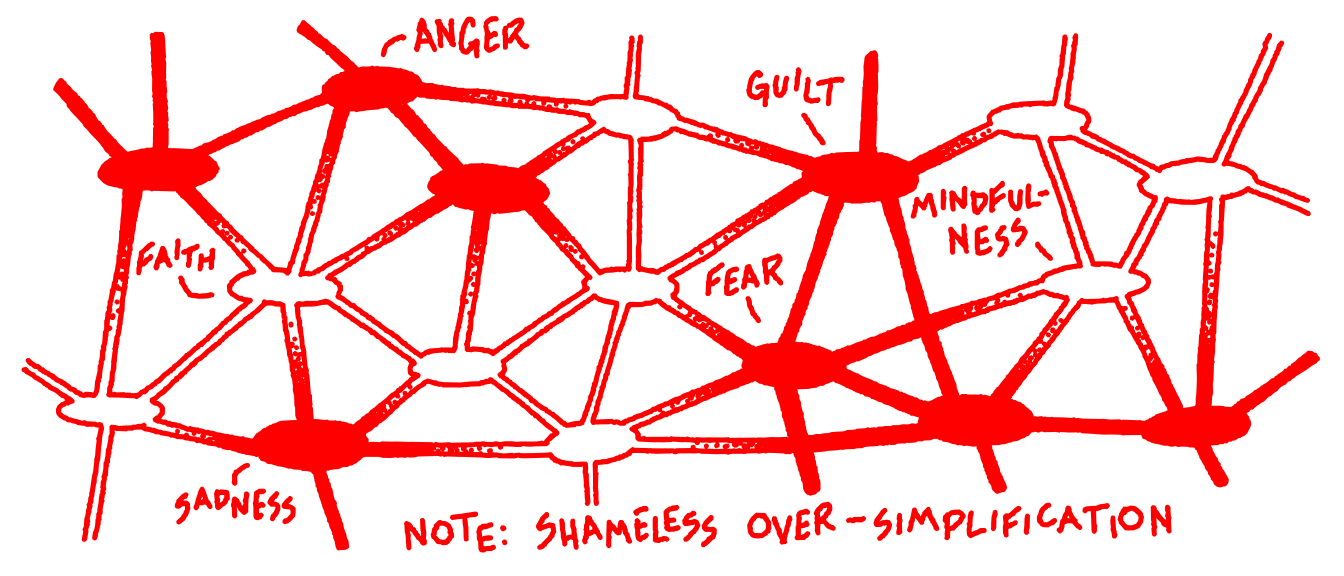
The second thing that is happening is a gradual, nearly imperceptible accumulation of familiarity with the contours of the formation. This is mostly unconscious and non-conceptual, but eventually it will make itself felt with a series of micro-realizations such as the surprising recognition of the intermittency of the anxiety. This is an almost tactile familiarity. It arises from sustained contact, and through this he discovers many things. He knows what the anxiety actually feels like, which allows him to detect it much more easily. He finds, to his dismay, that it is present in many corners of his life, in places where he had assumed he was free of it. He sees how it contributes to spats with his wife, how it dovetails into financial ruminations, and how it takes the form of the fear that he is missing the childhood of his two sons. Although what initially appeared to be a problem with shoes has blossomed into a full-time job, Jim does not blame the practice of mindfulness. Over the weeks and months of practicing with his anxiety, he has realized that the feelings were always there, always functioning, only unrecognized.
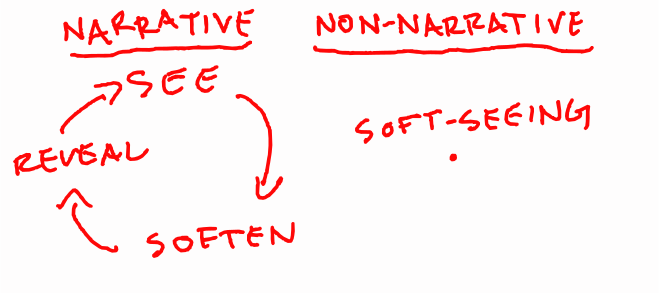
From our vantage point we can either create a narrative about this or not. In the narrative version, he first sees with awareness, then softens with compassion, and finally his contact with the formation deepens, meaning he is less entangled with the periphery. This is the story that eventually ends with the transformation of the root. In the non-narrative version, it’s just compassionate awareness all the way down. In this version, the root itself never even needs to be recognized as such, and neither does its transformation. Welcome to the path of non-attainment, the island that Jim Bootman is living on.
In our tale, however, we can reason about what may be happening. Jim’s internal formation came about by an unconscious contraction away from unpleasant feelings. That aversive movement became habitual, and took up any material in Jim’s life–conceptual, perceptual, or relational–that would allow it to proliferate itself. This was the construction of the periphery. The whole motive force is the resistance to the unpleasant vedana, which he is now directly counteracting with mindfulness and compassion. To grossly oversimplify, Jim Bootman is retracing his steps.
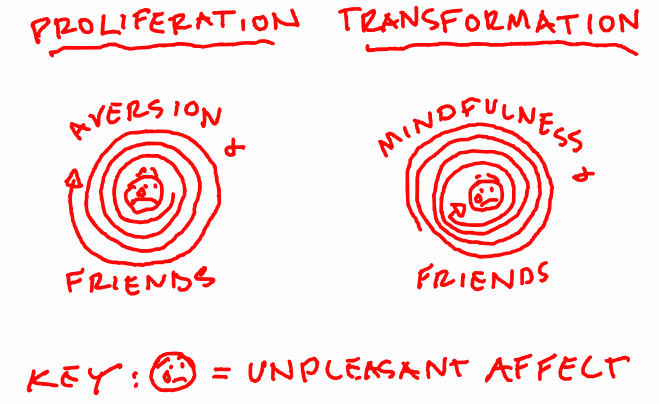
Does Jim Bootman have to mindfully and compassionately re-think every rumination of his 25-year career as a cobbler? I don’t think so. I have a sneaking suspicion that he is going to have some phenomenal breakthroughs with his internal formation next week.