
Transforming Internal Formations pt. 2
From the framework that we’ve explored so far, it looks as if present moment experience is determined entirely by which seeds are currently active. If we were to continue along this line of thought, it would be natural to assume that the configuration of the next moment would be determined solely by what seeds are activated by this moment. Experience in this moment would be “the causes and conditions,” and what follows would arise based on those causes and conditions. But this would lead to a slew of problems that would make both ordinary experience and transformation impossible. I’ll give an example that anyone can relate to:
You are walking around a crowded market and see a face–the face of an old friend. You make your way through the crowd and shout her name, “Hortencia!” But she fails to look in your direction. You shout louder, but to no effect, and now you’re wondering if she may be harboring a grudge. What could it possibly be? Suddenly, you remember that you failed to finish her acclaimed cucumber-mint soup at the 4th of July barbecue. She seemed understanding at the time, but one can never be too sure.
Finally, you reach her and tap her on the shoulder, but as she turns toward you, your stomach drops. This is not your dear old friend Hortencia at all, but Horatio, your lifelong nemesis! His beady eyes flick over you and a condescending smile curls his lips. “Well, look who it is… Still cleaning up after those pathetic little runts at the family center, I’m told? That suits you. I, on the other hand, was promoted to lead custodian at the university this year.” Damn you, Horatio! You smug bastard!
If seeds are activated by specific causes and conditions, how could a moment of cognition lead to the activation of the wrong seeds? To answer this question I will be forced to diverge from the language of “watering seeds,” and introduce my own misleading simplifications. The problem is that in traditional Yogacara, the history, strength, and activation conditions of a given seed are expressed in terms of vasana, the conditioning-pattern of the seed that has accumulated through past actions. This pattern is what updates each time the seed manifests and returns to store consciousness. Strictly speaking the seed and the conditioning-pattern are just two modes of the causal potential, kind of like how an electron can be conceived of as a wave or a particle depending on the context (with the words “kind of like” underlined ten-thousand times in red ink.)
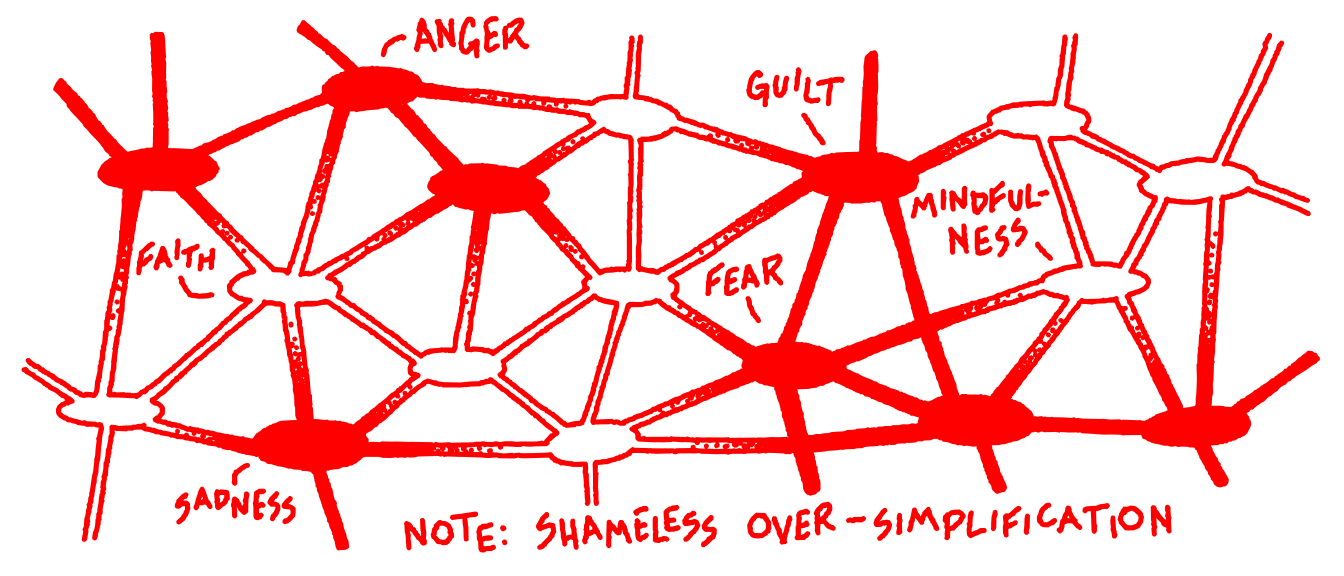
This conditioning-pattern operates at the level of the individual seed, the seed cluster (local vasana), and the totality of the store (global vasana). It is this, not the seed type itself, that determines what conditions will activate the seed, the strength of the activation, etc. At the local level, the combined conditioning-pattern is what coordinates the seeds in the cluster, which is how the cluster arises so coherently. At the global level, it is the determining factor for what seeds can possibly arise in any set of conditions.
When you met Hortencia all those long years ago, you never had an exact representation of her to imprint into store consciousness in association with the new, “Hortencia,” conceptual seed that arose, conditioned by the experience. All you had were a series of sense impressions, affective impressions, and cognitive impressions. When the Hortencia seed was sown, a new cluster was formed coordinating it with these sensory, affective, and cognitive seeds, all tied together by the conditioning-pattern. Upon your second meeting, there was a moment in which eye-consciousness processed a pattern of color, movement, light and dark, that was close enough to a previously coordinated pattern to activate the cluster, and in the very next moment that pattern of visual form was revealed to be not just visual noise but a person, not just any person but Hortencia. This process is and always has been heuristic, not deterministic, meaning that the conditioning-pattern activates when the conditions are just “good enough.” Over the course of the relationship, that cluster has been reinforced and updated with countless additional impressions, such that you recognize her as she is now and would be startled to see her suddenly appear again as an 8-year old, but no matter how well-established the cluster is, there will always be the chance that in a certain light and at a certain distance, a visual impression of your arch-nemesis will activate the seed cluster of your dear friend.
Are you sleeping yet? Let’s get practical: the global conditioning-pattern doesn’t just determine what kinds of seeds can arise. It determines what seeds are likely to arise. If we talk about general dispositions or moods, the particular shapes that a human manifestation takes, we’re talking about vasana. The re-imprinting of new conditioning-patterns at the seed, cluster, and store level is what constitutes the transformation of consciousness. When seeds are coordinated by a vasana of grasping, they are said to be afflicted and support the arising of the afflicted mind. When they are coordinated by vasana of non-appropriation they lose their capacity to do so. These are the broad strokes and I have dragged you through this because it will be important before we are done.
Now, why couldn’t Joe Boatman just transform his internal formation on the spot, right there in his boat? The formation arose. All he had to do was to see it as dependently originated, right?
Allow me to remind you of what I mean when I say, “see it as dependently originated.” For insight to occur, there must be a stable harmonization of the Factors of Awakening. When these conditions are well-established, a kind of observational frame arises that makes it impossible to grasp upon the presently arisen phenomenon as “me” or “mine.” When the observable truth of the matter is seen in real-time, that the whole internal formation is only arising because of an array of interdependent causes and conditions, the formation cannot be resown in the old afflicted way. It returns to store consciousness imbued with a coordinating vasana of non-appropriation, and for the purposes of our story, never arises again.
The question is, when Joe Boatman was overwhelmed by his internal formation, was his mind the site of a stable harmonization of the Factors of Awakening? I think not! Would the recognition, “This formation is not inherent. This can be transformed,” have changed that? No, it wouldn’t have! But fortunately for Mr. Boatman, he was a bachelor with a penchant for meditation and a pension from his time in the merchant marines. He could afford to disappear into a secluded retreat for a few years.
Since Joe Boatman chose to transform his afflictions via intensive retreat, he can no longer be a helpful exemplar of the gradual path of transformation. But he has a cousin, one Jim Bootman, a cobbler by trade, who has an internal formation in dire need of transformation, one from which he is in no position to seek seclusion. Young Jim, and very unfortunately for him in light of his name and trade, is greatly distressed by the sight of all footwear. His relational context provides no means of escape, as the modest income he wins by his trade is required for supporting his family. Yet he has come to the determination, “I will transform this through insight!”
Or rather, why don’t you just walk a mile in Jim Bootman’s shoes, I say with tongue firmly ensconced at great distance from cheek. Imagine that you have become aware of a certain internal formation, that you are not going to spend your life in secluded retreat, and that you would like to transform it. In what way will your situation unfold differently from that of Joe Boatman?
Joe was totally unreflective about his internal formation of anger. As far as he was ever concerned, things just “made him angry.” This has a certain charming simplicity about it. You, on the other hand, will not be afforded this luxury. You will become aware, “This is anger. This is not a fact about the wide world. This is a fact about the tiny slice of the world I call me. If I practice with this anger, I can transform it.” What arises based on these causes and conditions? All kinds of stuff.
Afflicted Consciousness Mad-lib:

Hi! My name is __________ and I am  __________  _______  __________.
                 (name)            (affliction) (prep.)   (object)

Familiar cases:
Hi! My name is ___Jim____ and I am  _unnerved_  __by___  _loafers__.
Hi! My name is ___Joe____ and I am  __angry___  _about_  _boating__.

Previously un-encountered cases:
Hi! My name is ___Joe____ and I am  _critical_  __of___  ___anger__.
Hi! My name is ___Joe____ and I am  _ashamed__  _about_  _criticism_.
Hi! My name is ___Joe____ and I am  _confused_  __by___  ___shame___.
Hi! My name is ___Joe____ and I am _discouraged_ _by_    _confusion_.
This has at first the appearance of a multiplication of afflictions. In some traditional texts, this is the point where we will encounter heroic narratives about Mara the Tempter intensifying his assault, or the defilements lashing out like a snake in its death throes. Can you hear the dramatic music swelling? Take heart, my brave spiritual warriors, for we are the Children of the Buddha! For too many lifetimes have we toiled under the yoke of these ill-begotten afflictions! Aye, we may be outnumbered, but our hearts are pure! Hold firm to the studded buckler-shield of relaxation! Swing mightily the spiked mace of loving kindness!
In this kind of situation, for concreteness, let’s say in a moment of meeting shame and confusion with loving kindness, the thought may arise, “Why am I dealing with all of this junk? I started practicing because I wanted to transform my internal formation of anger. It seems like I’m practicing with everything but anger.”
My dear, this–right now–is the internal formation of anger. You have been practicing with it the whole time. If the situation is described in terms of “strong seeds,” this seems totally incoherent. What would seem to have happened is that you encountered a strong seed of anger, you encountered the path, and while practicing with the strong seed of anger you encountered many other strong seeds such as confusion, guilt, etc. Not so, not so!
Remember, from a practical perspective, the important thing about the conditioning-pattern is not the details about which seeds it coordinates, but the strength and frequency of those activations, and whether they have the characteristic of grasping or not. This already explains in much more detail why Joe Boatman’s original anger was so capable of changing its object based on conditions. The pattern was ready to coordinate any seed as an anger-object in a moment of consciousness. But it is not just the object that can change. The entire mode of consciousness can change without the underlying character of the conditioning-pattern changing.
Bold = the conditioning-pattern reactivating in each moment

Hi! My name is ___Joe____ and I am  __angry___  _about_    _boating__.
Hi! My name is ___Joe____ and I am  _critical_  _of my_    ___anger__.
Hi! My name is ___Joe____ and I am  _ashamed_ _about my_  _criticism_.
Hi! My name is ___Joe____ and I am  _confused_  __by my__  __shame___.
Hi! My name is ___Joe____ and I am _discouraged_ _by my_   _confusion_.
To call this an internal formation of anger, or of anything specifically, is just a conventional designation. This is just consciousness conditioned by grasping taking many shapes, and it is the site of the practice. This conditioning-pattern is what takes the imprint of awareness and compassion, of mindfulness, patience, curiosity, and care in everyday life, and this is exactly why the practice is not a frantic hunt to exterminate the afflictions. Such a thing would be nothing more than strengthening the vasana.
Hi! My name is ___Chad___ and I am _intolerant_ __of my__ _afflictions_.
One word comes to mind: compassion.
I’ll try and wrap this up next time. We’re going to have a part three, people!



Thank you so much. I really appreciate your texts, each one of them. Moreover there are always some “things” that make me laugh. The same in your meditations. At the end it brings lightness in all experiences and space. Many thanks.